How to Play Minesweeper: Rules, Numbers, Tips
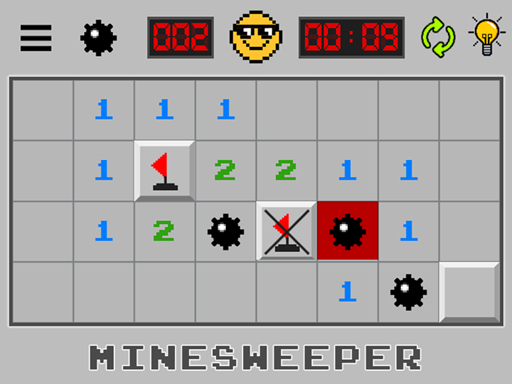
Minesweeper looks random the first time you play it: you click a square, numbers appear, and a few clicks later you hit a mine. In reality most of the game is pure logic. Once you know what the numbers mean and a handful of common patterns, you can clear whole boards without guessing. This guide covers the rules, the numbers, and the tips that help you actually win.
The goal of Minesweeper
The board is a grid of covered squares, and some of them hide mines. Your goal is to uncover every square that does not have a mine. You win when only mines are left covered. You lose if you uncover a mine.
Controls
- Left-click a square to uncover it.
- Right-click a square to place a flag where you think a mine is. Flags are optional, but they help you keep track.
- Click a number that already has the right number of flags around it to uncover all of its other neighbors at once (some versions use a middle-click or both buttons instead). This is called chording, and it saves a lot of time.
On most versions your first click is always safe, so start anywhere. A click in the middle of the board often opens a large area.
What do the numbers mean in Minesweeper?
This is the one rule that makes the whole game work. A number tells you how many mines touch that square. "Touch" includes all eight neighbors: left, right, up, down and the four diagonals.
- A 1 means exactly one of its neighbors is a mine.
- A 3 means three of its neighbors are mines.
- A blank square has no mines around it, which is why the game opens all of its neighbors automatically.
Everything else in Minesweeper comes from comparing these numbers with each other.
How to win: start with the easy deductions
Look for numbers whose count can only be satisfied one way.
- If a 1 has only one covered neighbor, that square is a mine. Flag it.
- If a number already has as many flags around it as its value, every other covered neighbor is safe. Uncover them.
- If a number has exactly as many covered neighbors as its value, all of them are mines.
Repeat these three checks around the edge of the open area and the board will usually keep opening up.
Common patterns to learn
Patterns are small groups of numbers that always solve the same way. Learning a few of them speeds up your game a lot.
- 1-1 from a wall: when two 1s sit side by side along an edge and the first 1 is next to the wall, the square beyond the second 1 is safe.
- 1-2: in a row of covered squares, a 2 next to a 1 means the square on the far side of the 2 is a mine.
- 1-2-1: the squares directly across from both 1s are mines, and the one across from the 2 is safe.
- 1-2-2-1: the squares across from the two 2s are mines, and the ones across from the 1s are safe.
Each of these works because the neighboring numbers share squares, so the mines they count have to be in specific places.
When you have to guess
Sometimes the numbers really do leave two equally likely choices, usually near the end of a game. When that happens, guess once and move on. If you have several options, pick the square that would reveal the most new information, such as a corner or a square next to a large blank area.
Difficulty levels
Classic Minesweeper comes in three sizes:
| Level | Board | Mines |
|---|---|---|
| Beginner | 9 × 9 | 10 |
| Intermediate | 16 × 16 | 40 |
| Expert | 30 × 16 | 99 |
Start on Beginner until you can win most games without guessing, then move up. Expert is where the patterns above really matter.
Play Minesweeper now
You can play Minesweeper on HopArcade in your browser, with Beginner, Intermediate and Expert modes. If you enjoy puzzles you can solve with logic, try 2048 next and see what the highest score in 2048 is.